Mud Tubes on the Foundation: Termite Signs at the Jersey Shore
Those pencil-width dirt lines on the block wall are worth a closer look before anyone paints over them.
October 21, 2026 · 4 min read
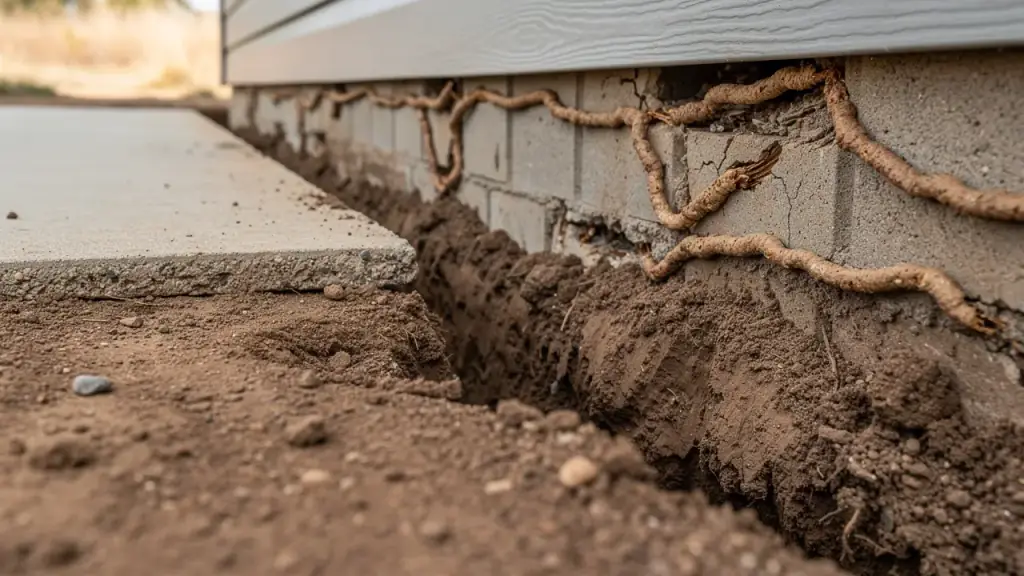
Most homeowners find termite evidence by accident. They're looking for a hose spigot, pulling out the snow shovel, or checking on a bulkhead door, and there it is on the foundation: a thin, dirt-colored line running up the concrete block, about as wide as a pencil. It looks like someone dragged a muddy finger up the wall.
That line is a mud tube, and it deserves attention. Before you scrape it off or paint over it, here's what it means, what else to look for, and how the treatment decision actually gets made.
What a mud tube is
Subterranean termites live in the soil and need moisture to survive. Open air dries them out. So when they travel from the ground to the wood in your house, they build protected tunnels out of soil, saliva and debris, and they travel inside those tunnels where it stays damp and dark.
You'll see these tubes on foundation walls, on piers in a crawl space, on the underside of floor joists, and sometimes running up from a slab edge. A tube that looks old and empty doesn't prove the colony is gone. Termites often build new routes next to abandoned ones, and the colony itself is usually underground, out of sight.
Other signs worth knowing
Tubes are the clearest clue, but they aren't the only one. Termites eat wood from the inside out, so the surface of a beam can look fine while the interior is hollowed. A few other signs tend to show up first.
- Swarmers in spring: winged insects crowding a window sill or basement door, often with a small pile of shed wings nearby
- Wood that sounds hollow or papery when you tap it with a screwdriver handle
- Paint or drywall that bubbles or sags, with no leak to explain it
- Doors and windows that begin sticking for no obvious reason
- Tiny mud-like pellets or blistered, layered wood along sills and joists
Winged ants and winged termites look alike to a casual glance, so don't guess. Catch a few in a jar or a piece of tape and let a technician identify them.
Why shore homes need a second look
The Jersey Shore combines conditions termites like: sandy, easily tunneled soil, a high water table, humid summers, and plenty of homes with wood close to the ground. Decks, porch steps, lattice, trim boards and fence posts that touch soil are all easy meals. Mulch piled against the siding can hide activity right at the sill, where you'd never see it.
Carpenter bees are a related problem worth mentioning. They don't eat wood the way termites do, but they drill neat, perfectly round holes in fascia, deck rails and trim to nest. If you see round holes about the width of your finger, that's a different pest with a similar fix: identification first, then the right treatment.
Baiting versus a liquid barrier
There are two main ways to eliminate a termite colony, and My Favorite Pest Control uses both: liquid barriers and baiting systems. People often ask which is better. The honest answer is that it depends on what the inspection finds.
A liquid barrier treats the soil around and beneath the structure so termites can't pass through to the wood. It tends to make sense when there's active feeding that needs to be stopped and the foundation can be reached. Baiting works differently. Stations placed in the ground around the home are monitored, and when termites feed on them, they carry the material back to the colony. It can be a good fit where drilling or trenching is impractical, or where you want ongoing monitoring built in.
Several things shape the choice: how the house was built, whether there's a slab, a crawl space or a basement, what the soil and drainage look like, how much of the foundation is accessible, and how active the colony is. A decision made over the phone, without anyone having looked at the foundation, is a guess.
The goal isn't to knock down the mud tubes you can see. It's to eliminate the colony. Scraping the tubes off feels satisfying, but termites rebuild, and you've also removed the evidence a technician would like to see. If you find tubes, leave them in place and take photos.
What you can do around the house
- Keep mulch, soil and wood piles several inches back from the siding and the sill
- Fix leaky gutters, downspouts and spigots that keep the foundation damp
- Keep wood trim, steps and lattice from touching the ground where you can
- Store firewood away from the house, off the dirt
- Look at the crawl space piers and joists at least once a year with a flashlight
How the inspection works here
At My Favorite Pest Control, every job starts with a full evaluation of the property, then identification of the exact species, because the right treatment depends on it. After treatment comes scheduled monitoring, and a detailed digital report follows every visit so you know what was found. Brian, the founder and lead technician, built the company around investigating root causes instead of just spraying.
Found a mud tube, a pile of wings or a soft spot in the sill? Call or text (732) 829-3881 and ask for an inspection. They cover Ocean and Monmouth Counties, from Brick to Long Branch.
My Favorite Pest Control, (732) 829-3881
Call (732) 829-3881More articles
Why Shore Houses Get Mice in the Fall, and What Exclusion Really Means
The scratching in the wall in October started weeks earlier, at a gap you probably walked past all summer.
Ticks and Mosquitoes in Ocean County Yards: Where They Breed and Wait
The two pests need different things from your yard, which is why one fix rarely covers both.